

Growth is exciting. Growth is hard. Growth also has a special talent for exposing every small crack in your operating model, usually at the worst possible time.
What worked beautifully at 20 people can feel chaotic at 50. What felt manageable at 50 can be confusing at 100. Communication gets harder. Training gets less consistent. New hires can feel like they joined a moving train. Somewhere, a spreadsheet is quietly becoming load-bearing.
That’s all normal.
I’ve worked with dozens of healthcare and healthcare technology companies over the years. I’ve watched smart teams scale well, scale poorly, and occasionally create chaos with the best of intentions. We’ve tried to learn from all of it.
At Greenbrook Medical, we’re not pretending we invented management. We’re borrowing the best ideas from organizations that have done this well, adapting them to our model, and trying to execute with discipline and humility. IMG
That last word matters more than it sounds.
1. Leave the Ego at the Door
There’s no room for ego in a growing healthcare company. Not because humility looks good on a values poster, but because ego is operationally expensive. It slows learning, blocks feedback, creates silos, and convinces people they’re somehow above the basics.
No one is above the basics.
In healthcare, every role matters, and most of the ones that actually move outcomes aren’t the glamorous ones. The MA catching a subtle vitals trend. The biller untangles a claim that would otherwise cost a patient a sleepless weekend. The coder who quietly saves the company a small fortune every quarter. The scheduler who fits in a same-day visit for a patient who called in tears. The operator who fixed the workflow that now saves everyone ten minutes a day.
Great outcomes come from a lot of people doing unglamorous things consistently well. Our clinics run flatter than the typical clinical environment for exactly that reason. We don’t treat any role as more important than another, because the math of patient care doesn’t work that way. Higher level does not mean higher value. It usually means broader scope, more complexity, and different responsibilities. The whole is greater than the sum of the parts, and the parts notice when you act like they aren’t.
The tone gets set at the top. Our CEO and CMO both sit down for structured 360 exercises and ask for pointed, uncomfortable feedback. Not the “what’s one tiny thing I could do a little better” version. The real one. They then talk openly about what they’ve learned, what they’ve gotten wrong, and what they’re still figuring out. When the people at the top model that, it gives everyone else permission to do the same.
The happy side effect: we’re not encumbered by ego when we need to rethink something. Team structures, training plans, the care delivery model itself. None of it is sacred. If a better version exists, we’d rather find it than defend the current one.
2. Kindness, Not Niceness
These two get confused constantly, and the confusion does real damage. It’s how companies end up with cultures that feel warm on the surface and are quietly rotting underneath.
Niceness is walking on eggshells. Softening feedback until the person receiving it can’t actually find it. Telling someone their work is great when it isn’t, because it feels easier in the moment. Niceness is optimized for the speaker’s comfort.
Kindness is telling someone what you actually think, respectfully and thoughtfully, with their growth in mind. Kindness is optimized for the other person. Over time, one of these builds trust and the other corrodes it, even though they look similar at a glance.
We try to bake kindness into the systems themselves, not leave it to vibes. Our peer and upward reviews insist on constructive feedback, and we teach people how to give it, with example answers that show what “constructive” actually looks like. (“Jenny is amazing” is sweet, but it is not feedback.) We coach people through it, and we put real effort into the psychological safety side so that giving honest input doesn’t feel like career roulette.
It shows up in our meetings too. We run them to encourage people to push each other’s thinking, disagree out loud, and poke holes in ideas, including the ones coming from the most senior person in the room. Polite silence is not the goal. Better answers are.
It also starts before anyone joins. We try to be clear and specific in the hiring process about who we are, how we work, and what we expect. We don’t advertise one culture in the window and sell another after the offer letter. Candidates should leave interviews knowing we care deeply about patients, value teamwork, move quickly, give candid feedback, and hold a high bar on performance. The right people lean in. The wrong people self-select out. Both outcomes save everyone a lot of time and a few awkward conversations down the road.
3. Hospitality Is the Whole Job
If there’s one cultural influence we’ve borrowed from outside healthcare and tried to push a few steps further, it’s hospitality.
Many of us have read Setting the Table, and its principles resonate. Details matter. People remember how they were treated. Excellence is usually the accumulation of small moments handled thoughtfully. A handful of operators outside our industry do this exceptionally well, and we’ve tried to borrow their obsession with it rather than just tipping our cap.
Healthcare should feel a lot more like hospitality than bureaucracy.
That applies to patients first, especially in a setting where people often arrive scared, confused, or in pain. Our clinics are decorated with artwork made by patients. Every so often, someone will stop by the front desk with homemade cookies, a jar of something canned at home, or a hand-written card, and those things tend to reach the break room table within about ninety seconds. We don’t frame moments like those as a KPI. They are the scoreboard, and we share them with all team members to feel the collective impact.
It applies just as much internally. How we welcome new hires. How leaders communicate change. How meetings get run. How someone is treated when they make a mistake. How we celebrate wins. How fast we show up when a teammate needs help.
That’s also why we take cross-training seriously. Leaders who haven’t lived the role they now oversee tend to struggle to coach it well. So MAs rotate through operations, operators spend real time in clinics, and managers learn the workflows of the teams they support. Same Setting the Table mindset, pointed inward. When everyone has seen the full picture, fewer things fall through the cracks, and patients feel the benefit without ever knowing why.
A quick word on feedback, since it lives here too. We’d rather it feel like routine maintenance than an emergency procedure. Praise should be specific, coaching should be timely, and performance conversations should be thoughtful rather than surprising. When feedback is normal, it’s less scary and more useful. When it’s saved up for six months, it tends to arrive loud, late, and dragging a U-Haul of stored-up frustration behind it.
The saying goes that culture is experienced in moments, not memos. We believe that.
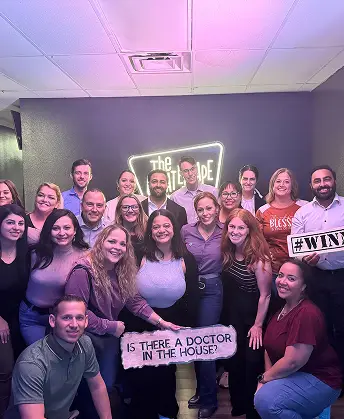
We also try not to take ourselves too seriously while we do any of it. Healthcare is serious work, and that can tip into self-seriousness in a hurry. Once a year the whole team gets together, not a strategy offsite wearing a party hat, but a real get-together. Food, social time, laughter, and at least one moment best kept off video. People finally meet colleagues they’ve only ever seen as small rectangles on Zoom. It matters. The rest of the year we try to keep the same energy in smaller doses. Humor in meetings. Specific celebrations of wins. A general belief that people doing hard work well deserve to enjoy the people they do it with.
4. Patients Come Second
This sounds provocative for about five seconds, and then it becomes obvious.
Patients matter most in terms of mission. They are why we exist. But if you want to sustainably deliver excellent care, the team has to come first operationally. Burned-out teams don’t create great patient experiences. Confused teams don’t scale quality. Unsupported managers don’t build healthy cultures. You cannot pour from an empty pitcher, and medicine is a lot of pouring.
So we invest in the team with the same seriousness we apply to clinical quality. Clear expectations, strong leadership, fair accountability, real appreciation, and workflows that don’t require a PhD to navigate.
One specific bet we made early: we brought on a Head of Learning and Development well before most companies our size would. She came to us from Maven Clinic, where she’d built a serious training function, and she transformed our culture within six months. Not by adding more compliance modules, but by making development feel like a promise the company actually keeps. We want Greenbrook Medical to be known as one of the best places in healthcare to grow a career, and that aspiration takes more than a LinkedIn post about it.
Happier, healthier teams provide happier, healthier care. It isn’t complicated. It’s just hard to stay disciplined about.
5. Scaling Is About Intentionality
As companies grow, complexity sneaks in wearing the costume of sophistication. We try to fight that instinct wherever it shows up.
One small example we lean on often: Neil’s 16-point font rule. If a message needs a tiny font and three footnotes to explain itself, it probably isn’t ready yet. Simplify, then send.
Scaling, for us, is mostly a streamlining and consolidating exercise. Cut the second dashboard that nobody trusts. Merge the three overlapping processes into one that people can actually remember. Write the thing down in plain English so the fifth person to join the team doesn’t have to reverse-engineer it from Slack scrollback at 11pm.
Simple is harder than complicated. It takes sharper thinking and a willingness to kill your own darlings. But simple scales, and complicated collapses politely under its own weight somewhere around headcount 80.
Scaling isn’t becoming more corporate. It’s becoming more intentional. It means preserving the heart of the company while building the systems needed for the next chapter. It means evolving what no longer serves you without losing what made you special in the first place.
We don’t claim perfection. Like every growing company, we’re learning in real time, usually with coffee.
But we do believe that humility, kindness, clarity, hospitality, and a healthy dose of levity are durable advantages. In healthcare, durable advantages matter.


